Tuesday, October 1, 2013

Poon Lim and the Seven Winds


It's about time we return to the catalog of Media Press, Inc., the Champaign, IL. company that gave us the work of James Cuomo among others.  A native of Wisconsin, Raymond Weisling (b. 1947) was fascinated both by electro-acoustic music and Javanese Gamelan, the latter of which led to him moving to Indonesia in 1980 and never looking back.  Before he decamped for water-locked pastures he had four pieces published by Media, and the most alluring of them is scored for a unique wind septet and paints a tone-picture of the story of Poon Lim:


(Click for larger view)

On 23 November, 1942, the British merchant freighter Belmond was torpedoed in the South Pacific.  The only surviving crew member, Poon Lim (born 1918), was rescued after spending 133 days and nights upon the waves in a small life raft.

Poon Lim...a Night Upon the Waves is an impression of the marooned night - no light but stars, no sound but waves.  While the score baffles at first, an instruction page is included.  The instruments enter in the order specified by the dotted arrows, and each note is held for the duration of a slow lung of air.  After the note is finished the player takes a slow, full breath, aligning tge music to biological processes.  The players continue at their own pace, and the texture is one of quiet, naturally asymetric pulses, like the swelling of waves beneath your back.  The ensemble is unusual, bottom-heavy and inwardly resonant, and one can imagine distant ship horns or whales.  There's no recording, but the effect can be easily reproduced at a piano and it's an easy piece to perform.  If you've got seven winds and a spare half hour Poon and I would love to make your acquaintance, but it may take a bit to scrape up a makeshift liferaft to attend the performance.

~PNK

Poulenc's Gloaming Sarabande


Though Francis Poulenc (1899-1963) needs no introduction here, it's important to note his career's parallel-yet-opposed relationship to Stravinsky's, from era touchpoints to their wildly differing interpretations of Neo-Classicism.  By the '60's, each man had attained lasting and unprecedented acclaim in their own craft, and at this time Stravinsky entered a super-concentration phase.  Perhaps his advanced age had given him the wisdom to say just as much with one stroke as others would with five, and I can't help but think that Poulenc felt the same of his own work.  He had never shied away from simplicity before, but now the close was near and the need to choose his words may have risen in priority.  Just a few years before his death, he wrote the Sarabande, his only work for guitar.

(Click for larger view)

The other leaf on David Leisner's album Music of the Human Spirit, Poulenc's meditative dance is a far and melancholic cry from Lou Harrison's Serenade.  Working with a slow heartbeat and the semi-stunted, chest-born resonance of the guitar, he weaves a haunting song with a minimal, yet effective, antique modality.  Much like Harrison he banks on repetition, getting a lot of mileage out of strains so natural they feel ingrained in our collective memory.  This isn't Neo-Classical so much as it is Neo-Baroque, harking to Dowland's lachrymose.  The guitar stands in for a lute, and the more limited resonance of the lute would work wonders here.  Once again Leisner's recording is my favorite, but there are about 17 dozen YouTube performances to choose from, including the very nice one below.  Consider the Sarabande a gift from me to you for a rainy day - Washington has entered the Wet and Dark, and so this piece seems more than necessary.


~PNK

Monday, September 30, 2013

A Serenade To Frank from Louie


I'd apologize for including this picture of Frank and Louie, the world's oldest Janus cat, but I can't resist any temptation to feature him.  The Louie pertinent to this article is Lou Harrison (1917-2003), a seminal American musical figure who transformed from Ultra-Modern to Faux-Eastern, carving out a very unique private world.  While most famous for his gamelan works (tinkering with Western instruments to replicate the sound rather than using the real thing), he was a prolific composer whose output covered many instrumental combinations.  By 1994 he had written enough works for guitar that Presser published The Lou Harrison Guitar Book, collecting six pieces from across his career, beginning with a leaf:

(Click for larger view)

Called Serenade here, I've also seen it called Serenade for Frank Wigglesworth.  Frank Wigglesworth (1918-1996) isn't really worth investigating, but I certainly won't keep you from your curiosities.  It's one of the few works he wrote spontaneously, authored in 1951 (or '52, my sources conflict) as part of a private letter to Frank.  Like much of Harrison's work it exudes a bucolic simplicity, bouncing off the major scale in rapidly shifting meter, and its openness allows for instinctual stretching of tempo and dynamics.  It's as attractive as any guitar work I've heard, and fits in nicely with the American classical guitar idiom, a world unto itself untouched by the ravages of modernism, much like choral music.  There are several recordings, my favorite being David Leisner's on his album Music of the Human Spirit.  For those of you who can't secure a copy, here's two semi-par YouTube performances: 1. On a guitar tuned in just intonation (better explained by the video description than by myself):


2. On a normally-tuned harp:


The guitar is an ideal instrument for leaves, with its intimate resonance and history with music-making in living rooms and porches.  There are plenty more six-stringed leaves to come, and the next leaf is another offering from Music of the Human Spirit, which I'll leave for you to ponder over.  The Serenade is a balm for the brain, so I hope there are enough ideas for me to start up a betting pool.

~PNK

Sunday, September 29, 2013

Twelve can play at that game, Josef


A piece of wisdom lent to me through several hands stated that there are two kinds of composers: wolves and moles.  Wolves spend their careers roaming musical wilds, picking up techniques and passions when they find them.  Moles see one point and burrow as far towards it as they can.  After spending some years roaming the wilds of expressionism, Josef Matthias Hauer (1883-1959) plunged into moledom.  His point was the zwölftonspiele, or twelve-tone games, and he wrote them exclusively after 1940, thousands of which only a small portion remain.  While his technique is too complicated to explain here it is important to note that he developed his brand of dodecaphonic music at least a year or two before Schoenberg and found a totally unique method without receiving even a fraction of the same acclaim Schoenberg did.  Rather than working with rows, Hauer focused on pairs of hexachords, resulting in brief, enchanting works for every instrumental combination imaginable.  My favorite is (Christmas 1946), but this leaf for clarinet is quite charming.


(Click for larger view)

"Playing" off a twelve-tone row by Ernst Hartmann (of whom I haven't the foggiest), there's really not much to say about the thing.  It's just casually hanging out in the living room, mug of tea in one hand and a P.G. Wodehouse novel in the other.  This recording says it better than myself, so why don't you just go outside and play with your new friend Joey.


~PNK

Friday, September 27, 2013

Tres Rimas de Vactor


The music of David Van Vactor (1906-1994) could best be described as charmingly backward.  His stubbornness to adapt to a changing musical landscape has ensured a niche audience rather than a broad one - music academia has largely ignored his output while the public has been left uninformed via a lack of blow-the-doors-off opuses.  This isn't to say there's no quality to be found, but rather that he fell in line with Middle-American (born in Indiana, flourished in Tennessee) composers of his ilk and held desperately to Neo-Romanticism (such as Herbert Elwell).  American composers of the time didn't have as much pressure to get with the Moderns as their European counterparts, and publishers successfully pushed against modern trends well into the '40's before finally cracking.

Vactor sits at an interesting state of compromise between the Ultra-Moderns and the Old Guard, and was arguably the most conservative composer to be featured in Henry Cowell's New Music Edition, a seminal modernist journal that needs no introduction here.  His issue is dedicated to songs he wrote in the '30's, all of which were re-engraved for his free-to-download catalog at Roger Rhodes Music, which is where I found them.  And nestled among the freebies were three leaves, ripe for plucking.

(Click for larger view)

Each of them is a setting of rimas by Gustavo Adolfo Bécquer, one of the most important figures in Spanish literature and, for our purposes, a very talented poet.  The rimas (rhymes) are very brief and often heartbreaking, and the three Vactor chose all concern the bittersweet realities of love.  Vactor's language is here at its most impressionistic, setting each rima as if trying to balance a needle on rippling water.  Rima XXI is the most fragile of the three, requiring deft pedaling and an even tone in order to not break the surface.  There's no particular order to the songs, so I've ordered them to follow the numbering of the poems.  And if I've mispronounced any of the Spanish I'll apologize in advance.


(Click for larger view)

Rima XXIII sidesteps any notions of bright-eyed, youthful love in favor of warmth and world-weariness, its harmonic language drenched in absinthe.  The prospect of a kiss brings the singer to deep sighing, and the low register of the piano is exploited to a vaguely ominous effect.  The vocal line ends on a minor seventh in relation to the bass, a strikingly unresolved note at the bottom of the singer's range (for a high voice like mine, anyways).


(Click for larger view)

Rima XXXVIII is the most overtly oceanic, with rich mid-range ripples planing in opposite directions.  While the tone of the music is the most uplifted the poem is as melancholic as they get.  After the listener is lulled into a sense of barcarollian calm, Vactor throws in a loop: the final question to the poem's subject cracks the heart in a thousand pieces, as if Bécquer conceived it staring across the expanse of the Mediterranean at twilight.  Each of the Rimas is touching in their own right but XXXVIII has the greatest moment, and Vactor's take is priceless.  If you've got a hankering for more of his work the door's wide open, but if not these small sapphires can shine quite brightly on their own - and perhaps they're more poignant if it's kept that way.


~PNK

A Pair of Birthday Cards from Donald Martino


It's notable when a man reaches great recognition for his art while having his works entirely self-published.  It's more notable when that publishing company is named after a Great Duke of Hell:
                                              =               

Donald Martino (1931-2005) became one of the most acclaimed serialist composers of his generation, sticking to his guns at a time when the future of serial composition was looking dimmer each day.  Taking the baton from his teacher Luigi Dallapiccola, Martino shook off the stereotype of serialism as the realm of the dry and emotionless, crafting an impressive oeuvre both rich and enveloping.  After winning the Pulitzer Prize in 1974 for his chamber work Notturno, it's natural to assume he'd spent some time before that sticking tubes into clarinets:


As can be gleaned from a cursory search Martino was a clarinetist and wrote a great many pieces for the instrument, such as the oft-recorded A Set for Clarinet and the Triple Concerto for clarinet, bass clarinet and contrabass clarinet.  So with his decades of experience both behind the music stand and behind the behind of the music stand, it's logical for him to engrave birthday cards he wrote for his friends.

(Click for larger view)

Using the French musical cryptogram system (the same one used by Debussy and Ravel in their Hommages to Haydn), Charles: Happy Birthday to You turns the first name of Charles Wuorinen into a motive for the fellow serialist's 50th.  Written in a wild improvisatory swoop, Martino's elaborations mirror the volatile, often stuttering nature of Wuorinen's music, leaving no key unpressed and vaulting across the whole of the clarinet's range.  "Happy Birthday" makes its appearance in the most ear-splitting manner possible, possibly a commentary on its obscene overuse ever since the Hill sisters couldn't keep their pens capped.  The best part of this is that there's another one:


(Click for larger view)

At this rate John Heiss'll think Donald's trying to get a piece of his turf.  This time the recipient is Arthur Berger, whose general obscurity in the public eye is matched only by the love by his friends.  I haven't the foggiest as to how he derived the motive, but the zoop up and down the staff in the "X" bar should clear the fog right up.  Berger's music, while serial in his life's later half, was always much calmer and more thoughtful than Wuorinen's, and 15, 5, '92 A.B. is appropriately smoother.  That "X" bar also has a double tenuto marking on the high "D", a trick I've only seen elsewhere in pieces by Thomas Adès and Kaikhosru Sorabji.  At the end we get a similar cryptogram, this time presumably of Martino's own birthday and at a much quieter dynamic level, implying that Martino pales in comparison to his elder friend.  As I'm not here to play favorites (too much), we'll just say that whomever is humble in the other's presence, they both won.

~PNK

Saturday, September 21, 2013

Shimmy on down that road, Georgie


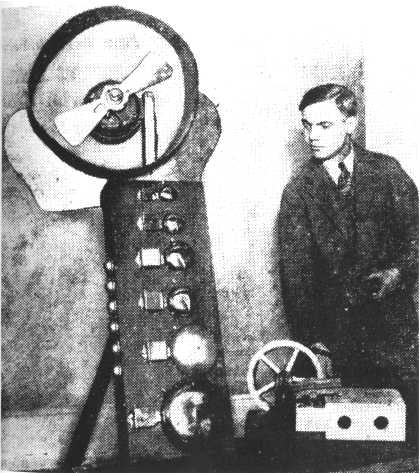
Considering that he gained (or self-applied) the moniker "Bad Boy of Music", it's nice to remember that George Antheil (1900-1959) had his nice moments.  A restless semi-trickster of the early American Avant-Garde (often lumped together with Henry Cowell and Leo Ornstein by the lazy), Antheil was a notorious personality in his day, bouncing around Europe and causing fistfights with his Ballet Mécanique, originally scored for 16 synchronized player pianos and percussion (including two airplane propellers).  And don't even get me started on his work helping Hedy Lamarr invent a wireless transmitter using player piano components*.  Poorly understood in his lifetime and prone to fits of style-shifting, the majority of his works were published either quite late in his life or after his death, with editors forced to sift through piles of odd-looking manuscripts, Ives style.  Some of his works were so bizarre and short it's no wonder they had a hard time seeing print, such as the Jazz Sonata for piano, written in his jazz deconstruction period in the 20's.  And from this same brain we are given a smile from where the sidewalk ends - the Little Shimmy.


(Click for larger view)

I realize that with this post I've made a trilogy on pseudo-jazz piano leaves, and when treading the murky waters of pseudo-jazz one has to watch out for condescension.  When early jazz swept across Europe in the inter-WW years a big part of its novelty was its origins with black culture, and many composers imitated contemporary jazz crazes with a nice heap of racist under- (and over-) tones.  It's hard for me to think of a leaf with malice, so when the threat of foolishly posting something offensive rears its ugly mug I get a bit scared.  Fortunately, this little guy comes without message, singing nothing more than itself.  I'm a bit surprised I even got two paragraphs here, as there's really nothing much to say about the piece, except that it's a shimmy written in a low-calorie incarnation of Antheil's harmonic approach from this time.  I could compare it to a lost tire nearby a Nebraska gas station, but you thought of that already.  I can't be certain if there'll be more leaf trilogies, but we've got to shimmy on to find out.


~PNK

*I'm not kidding.