Friday, August 16, 2013

The Catch Club Sings to Suck Poor Mortals Dry

Choral music from the 18th century has to try pretty hard to be revived by modern choirs, let alone get radio play and recordings.  But William Hayes (1708-1777) found a way.  Trained at Gloucester Cathedral as an organist, he spent most of his career at Oxford, both as an organist (at Magdalen College) and composer.  He helped build the Holywell Music Room, Europe's oldest purpose-built music room, and was elected a "Privileged Member" of the Nobleman's and Gentleman's Catch Club.  A catch is a short piece of imitative counterpoint for two or more voices (usually at least three), and often contain a phrase in words that is revealed by overlapping or intersecting, oftentimes subversive or crude.  Hayes was no stranger to catches and glees (the source of the Glee Club), and he got an award for this leaf:


(Click for larger view)

However, the leaf I'd like to focus on is much more hilarious.  The vampire legend as we know it today didn't branch out from its Transylvanian homeland until the mid-18th century, which we all know was the birthdate of the gothic novel (The Castle of Otronto).  As the Western England Hoity Toity must have seen vampires as a quaint, amusing quirk of backwards folk, a catch was inevitable.


(Click for larger view)

Published in Hayes's second book of "Catches, Glees and Canons" in 1765, The Thirsty Vampires (or Thirfty, as I don't have that old-fashioned light "s" letter) couldn't be more appealing as a proto-horror curiosity.  I love that vampires were thought as a plausible explanation for tuberculosis, and the notion of piercing graves baffles me.  The moral appears to be a wish to drink as much wine as possible in life so as to become a vampire in death and drink wine forever; I have no idea why that's not a movie.  I'm no expert on how to sing these pieces, and I've been unable to track down instructions, so you're on your own as to how to perform it properly.  I was able to find a midi recording, though, but they've chosen a lute setting and it doesn't fix the problem of hearing all the words at the same time.  Just go here and click the yellow speaker button, clearly sourced from an educational PC program from 1996, which was of course the intention of William Hayes when he wrote the piece.

~PNK

Thursday, August 15, 2013

Vivian Fine sends a love letter from the Dark World


There's nothing more crestfalling than being asked what you accomplished in your youth, as if the standard is set by the prodigal and lucky.  Classical music has dozens of wunderkinder for every instrument and medium, including the Fab Four of Mozart, Prokofiev, Mendelssohn and Korngold (which I just made up).  Vivian Fine (1913-2000; hey, it's her centennial!) has probably never been counted among these luminaries for this or any other position, but considering her first serious composition was written at 16 and displays a unique modernistic language right out of the gate, we'll have to add her name to the list of enfants irrepressible.  Fine had a long and distinguished career, penning more than 140 compositions and teaching at Bennington College for 23 years.  To the benefit of people like me her estate has posted the bulk of her pieces on IMSLP under a Creative Commons license, such a generous act that I may have to make an "On the Vivian Fine collection at IMSLP" article in the future.  For now, let's look at one of her first published works, which made waves at its premiere...when she was 20.  Dammit.

Premiered at a League of Composers concert in 1933, the 4 Songs for voice and string quartet are astonishing feats, intense and eerie settings of what are largely unassuming, yet elusive, love poems.  Sitting squarely in her first period, atonal counterpoint (much like her ultra-modernist colleagues such as Ruth Crawford and Carl Ruggles), each song illuminates the text with unique instrumental pairings, deft vocal writing and haunting colors.  The voice setting is so good that one critic said, "Only Virgil Thomson’s setting of the English language rivals it among 20th century composers. It is natural, perfectly speech-like, yet measured and expressive."  The songs are split in half by source: the first two are 16th-century British settings, the latter two from James Joyce's Pomes Penyeach.  I'd say that there are too many Joyce settings among 20th century art songs, but Fine's contributions to the rep suggest there aren't enough.  My favorite of the four songs is the third, "She Weeps Over Rahoon", which employs icy, pianissimo harmonics to scrape along the retinas, very fitting of a poem that darkly glowing.  However, the only leaf among them is the first, "The Lover in Winter Plaineth for the Spring."


(Click for larger view)

Based upon an anonymous Elizabethan text - 

O Western wind, when wilt thou blow
That the small rain down can rain?
Christ, that my love were in my arms
And I in my bed again!

                                                                           - Fine leaves the voice alone with a viola, working through a staid and desolate 12-tone row that switches gears at the pp.  The voice follows suit in a strikingly complex, off-centered rhythm.  As the poem's narrator is alone in damp anticipation, the music arcs and doesn't arc, remaining an elliptical procession to the end.  The atonal writing strikes a delicate balance between expressive and disarming, giving enough to follow but not necessarily understand.  It's also a rare piece that benefits from a dry performance area, as the recording included on IMSLP proves.  For some reason the dull room noise makes the heaving loneliness of the music ring that much more unnervingly.  I'd try to come up with an ideal listening environment, but I can't do much better than Joyce's Rahoonian environment - "moongrey nettles, the black mould and muttering rain."  Check out all the songs, score and recording, here, but wait for a grey moonrise.  It'll be better that way.

~PNK

Sunday, August 4, 2013

One Harvey-Haiku for Sunday night


British composers
Think they can write haiku too;
It turns out they're right.


~PNK

A crab for KRAB (almost)


I used to frequent a record store in Tacoma, WA called House of Records, which boasted some impressively overstuffed racks of all genres and times.  I especially liked riffling through the "20th Century Classical" rack, as it was a blitz of disorganized, mostly obscure items of not only recognizably classical artists but also plenty of odd 'tweeners with nowhere else to go.  These lonely discs were $2 a pop unless otherwise marked, and I snagged a number of fascinating items, most notably a number of records with "KRAB" written across them with a black marker.  At first I thought it was somebody's name, or at least a nickname, and I remember thinking to myself, "Man, this Krab guy sure had an interesting record collection!"  It was interesting, a mixture of Avant-Garde jazz, classical, world music and experimental, none of which I'd heard of before but all of which beckoned my ears.  As it turns out the Krab in question was really KRAB, a defunct Seattle FM radio station that I'm not old enough to have witnessed live.  Founded in 1962 in an old doughnut shop building, the listener-supported station was an experiment in free-form programming, allowing a passle of young eccentrics to broadcast whatever they thought was interesting, resulting in an eclectic, commercial-free mix of genres with unique announcers in the mix.  And in an unconventional turn of events the founding of the station also saw an odd little gift from a local composer.


(Click for larger view)

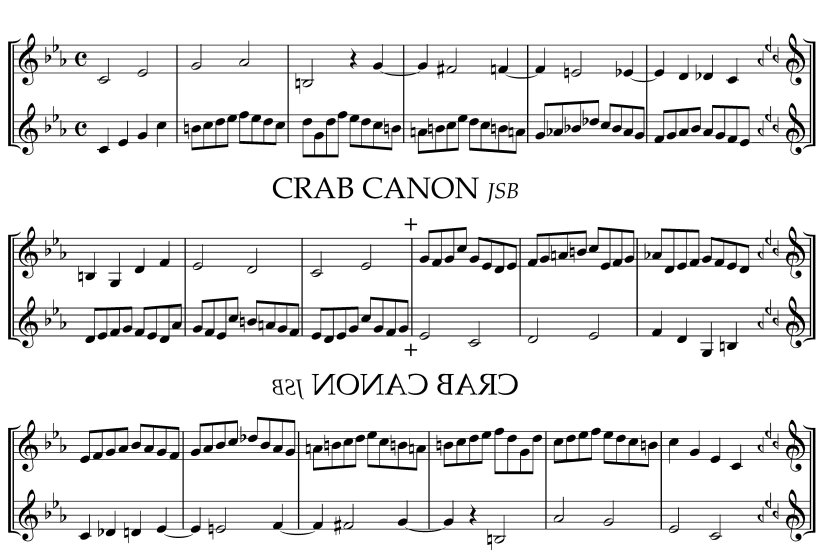
Luckily for those who don't care I don't know much about Henry Leland Clarke.  He got his degrees at Harvard and ended up teaching at the University of Washington in his later years, retiring Professor Emeritus in 1977 at age 73.  He was a member of the Composer's Collective of New York, a group dedicated to making songs for the working class, and worked under the pseudonym J. Fairbanks.  He was also a member of the American Composers Alliance, certainly the only organization to publish something like this, and I can't pass up any chance to link to them as per my undying love for their work.  I certainly didn't seek out any of his work; I came across this piece by happenstance while looking for works for voice and violin at the UW music library.  The Puget Sound Cinquain may not actually be for violin, as it doesn't state that on the score and I have no other information on the piece than what's in front of me.  Either way, it's labeled "Crab Canon for KRAB", and it's 1962 date of composition tells me that it my have been written as an inauguration piece for the station.  Another issue is that it isn't actually a crab canon.  A crab canon is a Baroque form of imitative counterpoint (two voices where the second imitates the first and its entrance is staggered), where the piece repeats itself in an inverse retrograde version at the halfway point while still sounding like a piece of music.  I've also seen examples where if you simply turn the page upside down it looks identical to the right-side up view.  Here's an example of the former from Bach:

(Click for larger view)

If you'll notice in Clarke's version, the lower line does retrograde in the middle, but that has no effect on the upper line, which is just an iteration of the subject.  Even if it isn't a crab canon per se, it is a cinquain, a brief poetic form inspired by Eastern forms such as Japanese haiku and pioneered by Adelaide Crapsey.  The criterion is a stanza of five lines with a stress order of 1, 2, 3, 4, 1 and a syllable order of 2, 4, 6, 8, 2.  The cinquain here, written by the acutely obscure Wallace Bartholomew, follows that form nicely:

A bit
Of the ocean
That wandered far inland
Became entranced and decided
To stay.

It's a nice little picture of Puget Sound which fits in brevity and cuteness Clarke's music.  Sidestepping modernism entirely, the quasi-canon sings in a clear-eyed E-major, meeting a charmingly simple poem with charmingly simple music.  Violin would be an obvious choice for the lower line, creating an atmosphere of acoustic intimacy as if the performance is taking place on a back porch.  I'd be interested to see the piece done by one person on both lines, perhaps as an encore to a grassroots concert.  I'd be curious to know how this piece was fit into a KRAB broadcast, or if it was ever broadcast, or practically any other information on its genesis or legacy.  Does anybody know about it?  Anybody?  Either way, it's a lovely miniature that I'd record myself if I had a violin.  In the meantime, here's a beautiful, entirely different piece for voice and violin I was reminded of looking at the Cinquain, a folksong arrangement by the New Englander Howard Boatwright:


~PNK

Sunday, July 7, 2013

Taking Little Stock(er) is Better than No Stock(er)


In the course of the completely unsystematic way I find obscure works I've run across comparatively few composers from Minnesota, home of most of my extended family, aside from the wonderful Aaron Jay Kernis and the less wonderful Rolv Yttrehus.  Carl Ruggles doesn't really count, as he was a New Englander for most of his life and only spent a handful of years in the state despite his vigorous efforts to turn a local orchestra into a new music powerhouse.

One Minnesotan that came to the fore in my research as quickly as I was unable to find any other pieces of theirs was Clara Stocker, a figure obscure enough that I wasn't able to find any pictures of her online (hence the condensed score header above).  Born in Duluth and taught early on by her mother Stella, Stocker was a music critic to two different Duluth newspapers (the News Tribune and the Herald) and wrote program notes for the Duluth Symphony.  She also taught French, and one of her most interesting studies was an attempt to teach phonetics using musical notation, or tonetics, and wrote papers on French Tonetics in the 20's which are available through Internet Archive (and more completely in JStor if you've got a institutional registration).  She was also deeply interested in Finnish culture and art, maintaining a friendship with the painter Juho Rissanen and writing a number of works based on Finnish music and legends (including the only other piece of hers to be published, a set of Finnish folk song arrangements for recorders).

The only piece of hers I've seen in print (aside from those recorder pieces) is the Two Little Pieces for piano, published in 1937 by the seminal periodical New Music Edition (which has been previously featured here) along with two pieces by the Cuban composer Alejandro García Caturla.  They were the result of the summer of 1936, spent studying with John J. Becker, a member of the American Five and someone I'll get to later (with one of my own performances to boot).  Becker was a pioneer of free dissonance and an important, if now forgotten, figure in the birth of modernist music in America, and Stocker's work here reflects his influence in its use of dissonant counterpoint.


(Click each for larger view)

Now, you'll probably see that the first of the two pieces is technically longer than a page, and that's fine, because I'm more fond of the second, and I never said that pieces shorter than a page weren't admissable (and we'll be seeing more of those soon enough *COUGH* Howard Skempton *COUGH*).  Both pieces are acidic contrapuntal whirls, fascinating little artifacts from a time when American music could have gone in any direction and not just the most academically provable and financially viable ones.  The first piece, Vivace, is too hard for me to make a recording quickly, and sounds best played as fast as possible to cover up wrinkles in the counterpoint.  The second piece, Moderato poco scherzando is an enchanting duet, like a pair of songbirds separated by mountain peaks.  Both of them are best played with sparse pedalling and a keen ear for harmonic flexibility, and I wonder how many other of her works are written in this style.  I've made a YouTube performance of the second one so you can judge for yourself how successful her tutelage under Becker was; I choose to think it worked out just fine.


~PNK

A Pair of Canadian Nostalgiana


While I was in college I would go develop little habits upon returning home for vacation, including going through some of my old piano lesson rep.  My favorite series of pedagogical collections was the Celebration Series, published by Frederick Harris Music to create printed versions of the Royal Conservatory of Music repertoire.  There wasn't a lot of modern music in these books (I only had volumes 4-7), but what they did have turned out to be unique for its reliance on Canadian composers (as it was a Canadian publication).  I got little encouragement to explore modern classical music from my teachers before entering college, so I played it by ear (sorry) and took what I could get, including works by Canadian composers I had never heard of before (and some never heard from since).  I went through them again recently and found two leaves that are quite nice, and I've made new performances of them for this blog.


(Click for larger view)

The more difficult of the two is Ghost Town by Clifford Poole (1916-2003), who taught at various universities including the Royal Conservatory of Music and the University of Toronto.  He appears to have written a lot of pedagogical piano music, as a cursory search on YouTube reveals about 20 different performances of his work on the first page alone (out of more than 1,000 matches).  Ghost Town is one of the more intense pedagogical pieces I've seen, and it'd be a good candidate for being reprinted in other collections, including American ones.  It's a very concentrated piece of writing, with effective materials and high expression.  I'd be a little curious to know if he had a particular ghost town in mind, as Canada is the possessor of a heck of a lot of plains territory that has a history similar to the American West (minus Mexico).  I never took a lesson on this one, which is a shame, but I've vindicated its name with this new performance (though not the only recording):


(Click for larger view)

Nestled at the very back of an easier collection, the lovely Barcarole (for Vivienne) is a nicely nostalgic piece of postludia, spanning nearly the whole range of the keyboard and featuring some really subtle writing for a children's piece.  I was also not taught this one, and though I have no proof of this its composer, David Gordon Duke, may have had trouble promoting his music in the U.S. because of the unfortunate similarity, in name and birth year (1950), to the notorious White Supremacy spokesman David Ernest Duke.  That, or nobody around here cares about his music, just like the majority of Canadian composers.  Too bad, really; I quite like this little piece, first published in 1977:


~PNK

Wednesday, July 3, 2013

Julia Perry Seethes a Jazzy Seethe


You think that music academia wouldn't leave any modernist stone unturned, especially if the composer in question is one as interesting as Julia Perry (1924-1979), who wrote a heck of a lot of music in her unfortunately short life (including seven symphonies and an opera).  She's among a small number of African-American female composers, the club also consisting of the likes of Florence Price and Dorothy Rudd Moore.  She was talented and lucky enough to study with Luigi Dallapiccola and Nadia Boulanger, and got a number of works published during her lifetime, though not many recordings.  One piece of hers I've taken quite a liking to is this short Prelude for piano, nestled in the pages of Black women composers : a century of piano music (1893-1990).

(Click for larger view)

A welcome addition to the pseudo-repertoire of American piano works that straddle the line between impressionism and jazz, the Prelude is a dark and seething reflection of the deep internal.  Those stacked chords are awfully satisfying to play, and in my performance below (which I think counts as the premiere recording [!]) you can see me dig into the keys, fully appropriate to the music.  It's midnight music, best played in low light and perhaps with a scotch at hand, and I'm a little peeved it hasn't entered the piano rep (yet).  I'm really glad I was introduced to Perry this way, as other works I've seen of hers seem to be somewhat harder to pin down emotionally, but far be it from me to prevent a note adventure.  Check her stuff out, and I hope my crack at the Prelude isn't too grating.


~PNK